


Hydrophobic Surface Treatments on Microfiber Suede Footwear
Nov 09, 2026

One-Stop Shoe Material Factory In China
Send your inquiry about shoe materials to Solamni and experience the transformative power it can have on your business or brand. With our premium material solutions-from high-performance outsoles to breathable uppers-you can elevate your footwear collections, captivate your target audience, and unlock new opportunities for growth and success in the competitive footwear industry.

Meta Description
Explore water-repellent microfiber suede, PFC-free DWR, wash durability, soft hand-feel, and colorfastness for footwear applications.
Hydrophobic Surface Treatments on Microfiber Suede Footwear
Hydrophobic treatments help microfiber suede footwear resist water droplets and everyday stains while retaining the material's soft, velvety surface. For sneaker manufacturers, the challenge is to improve water repellency without making the suede feel greasy, stiff, or unnaturally slick. Material approval should cover repellency after repeated cleaning, surface hand-feel, dry and wet crocking, and compatibility with the complete shoe upper construction.
A water-repellent finish does not make microfiber suede fully waterproof. Performance depends on the suede construction, treatment chemistry, application process, and exposure conditions.
1. Stain and Water Resistance on Soft Suede Sneaker Panels
Microfiber suede is used in sneaker panels because its fine-fiber surface can provide a soft touch and a suede-like appearance. However, its open surface structure can retain liquid and dirt if it is untreated or insufficiently protected.
A hydrophobic surface treatment changes the surface's interaction with water, encouraging droplets to bead rather than spread and penetrate immediately.

How hydrophobic treatments work
Water-repellent finishes typically reduce the surface energy of the treated fibers. Depending on the formulation, the treatment may be applied through spraying, padding, coating, or another finishing process compatible with the material.
For footwear applications, the treatment should address:
- Water beading: Droplets should remain on the surface long enough to be removed before absorption.
- Stain resistance: The finish may reduce the attachment of selected water-based contaminants.
- Surface appearance: Treatment should not create visible spots, uneven color, or excessive gloss.
- Breathability: The finish should not unnecessarily block the material's porous structure.
- Flexibility: The treated surface should withstand repeated bending without obvious cracking or finish loss.
Hydrophobic performance varies with liquid type. A water-repellent finish may resist clean water but provide limited protection against oil, detergent, or other low-surface-tension liquids.
Where water-repellent microfiber suede is used
- Common applications include:
- Sneaker toe and quarter panels.
- Casual footwear side panels.
- Outdoor lifestyle shoe uppers.
- Decorative suede-effect overlays.
- Selected footwear accessories and trims.
For panels exposed to frequent abrasion, the buyer should evaluate repellency after rubbing and flexing, not only on a newly finished swatch.
| Evaluation factor | What to inspect | Why it matters |
|---|---|---|
| Initial water repellency | Droplet beading and surface wetting | Establishes baseline performance |
| Water absorption | Change in appearance or weight after exposure | Indicates liquid penetration |
| Stain resistance | Response to specified contaminants | Supports easier routine cleaning |
| Surface appearance | Color, nap, gloss, and spotting | Protects product appearance |
| Flex durability | Finish condition after repeated bending | Relevant to moving shoe panels |
| Breathability | Air or water-vapor transmission where required | Helps preserve intended upper properties |
Water repellency should be specified according to the intended shoe use. A fashion sneaker, an outdoor lifestyle shoe, and a work shoe may require different levels of protection.
2. PFC-Free DWR Formulations and 30+ Wash Durability
Durable water repellent (DWR) finishes are designed to maintain water beading after use and, depending on the formulation, repeated cleaning. PFC-free formulations are increasingly considered by brands seeking to reduce the use of per- and polyfluoroalkyl substances in material finishing.
However, PFC-free does not automatically mean non-toxic, environmentally harmless, or fully compliant with every restricted-substance requirement. Buyers should review the chemical composition, supplier declarations, and applicable test documentation.

|
PFC-free treatment options Non-fluorinated water-repellent technologies may use different chemistries, including selected hydrocarbon-based, silicone-based, or polymer-based systems. Each has different effects on repellency, durability, hand-feel, and compatibility with microfiber suede. The right formulation depends on the fiber surface, finishing process, target performance, and restricted-substance requirements. |
|
Evaluating a 30+ wash target A requirement such as maintaining water repellency after 30 or more wash cycles should be treated as a project-specific performance target, not a universal property of PFC-free DWR. Before approving this claim, define:
For footwear, conventional garment laundering may not represent actual service conditions. A shoe upper may experience localized water exposure, dirt, friction, flexing, and cleaning with different products. The test program should reflect the intended care instructions and use environment. |
| Test stage | Evaluation | Purchasing purpose |
|---|---|---|
| Initial condition | Water repellency and appearance | Establishes the reference result |
| After cleaning | Repellency after defined wash cycles | Measures finish durability |
| After abrasion | Surface wear and repellency retention | Simulates friction during use |
| After flexing | Cracking, finish loss, and surface change | Checks footwear movement compatibility |
| Final inspection | Color, nap, hand-feel, and staining | Confirms overall material acceptability |
A supplier claiming 30+ wash durability should provide the test method, conditioning details, cycle count, and results. A wash-cycle claim without these details is difficult to compare between suppliers.
3. Maintaining Velvety Hand-Feel Without Greasy Slickness

For sneaker brands, these changes can affect both appearance and consumer perception.
Factors that influence hand-feel
Chemical formulation: The treatment chemistry determines how the finish interacts with the fiber surface.
Application concentration: Excessive add-on may leave a noticeable surface film.
Application uniformity: Uneven treatment can produce inconsistent touch and appearance.
Drying and curing: Inadequate process control may affect finish stability.
Nap condition: Mechanical brushing and finishing influence the final suede texture.
A successful treatment should provide the required water repellency with minimal change to the original surface character.
Balancing repellency and suede texture
|
Performance objective |
Potential issue |
What buyers should check |
|---|---|---|
|
Water beading |
Weak or uneven repellency |
Droplet behavior across multiple sample areas |
|
Soft hand-feel |
Surface becomes stiff |
Compare treated and untreated swatches |
|
Velvety nap |
Fibers become flattened |
Inspect under consistent lighting and touch conditions |
|
Matte appearance |
Excessive gloss or greasy look |
Check color and surface reflection |
|
Finish durability |
Repellency declines after use |
Repeat testing after cleaning and abrasion |
|
A practical sample approval process |
|
Before bulk production, request treated and untreated samples from the same microfiber suede construction.
Compare them under consistent conditions:
Inspect color and surface uniformity. Run a controlled water-droplet test. Compare dry hand-feel and nap recovery. Check for visible residue or gloss. Conduct the specified rubbing and flex evaluations. Recheck the surface after cleaning. The untreated reference is important. Without it, buyers may not recognize how much the treatment has changed the original suede character.
|
4. Dry and Wet Crocking Fastness: Evaluating Color Transfer
Crocking fastness measures the transfer of color from a material surface to another surface through rubbing. For microfiber suede footwear, both dry and wet crocking are relevant because the upper may contact socks, trousers, other shoe components, and damp surfaces.
A target such as AATCC Grade 4.5 should be defined carefully. AATCC rubbing fastness is commonly evaluated using a crockmeter method, while results may be reported using a gray scale or another specified rating system. The exact method, rating scale, and test conditions must be stated before comparing results.
A grade of 4.5 should not be treated as an automatic or universal result for every treated microfiber suede.
Dry versus wet crocking
Dry crocking: Evaluates color transfer under dry rubbing conditions.
Wet crocking: Evaluates color transfer when the rubbing cloth is dampened according to the test procedure.
Wet crocking can be more demanding for some dyed or finished materials because moisture may increase color transfer.
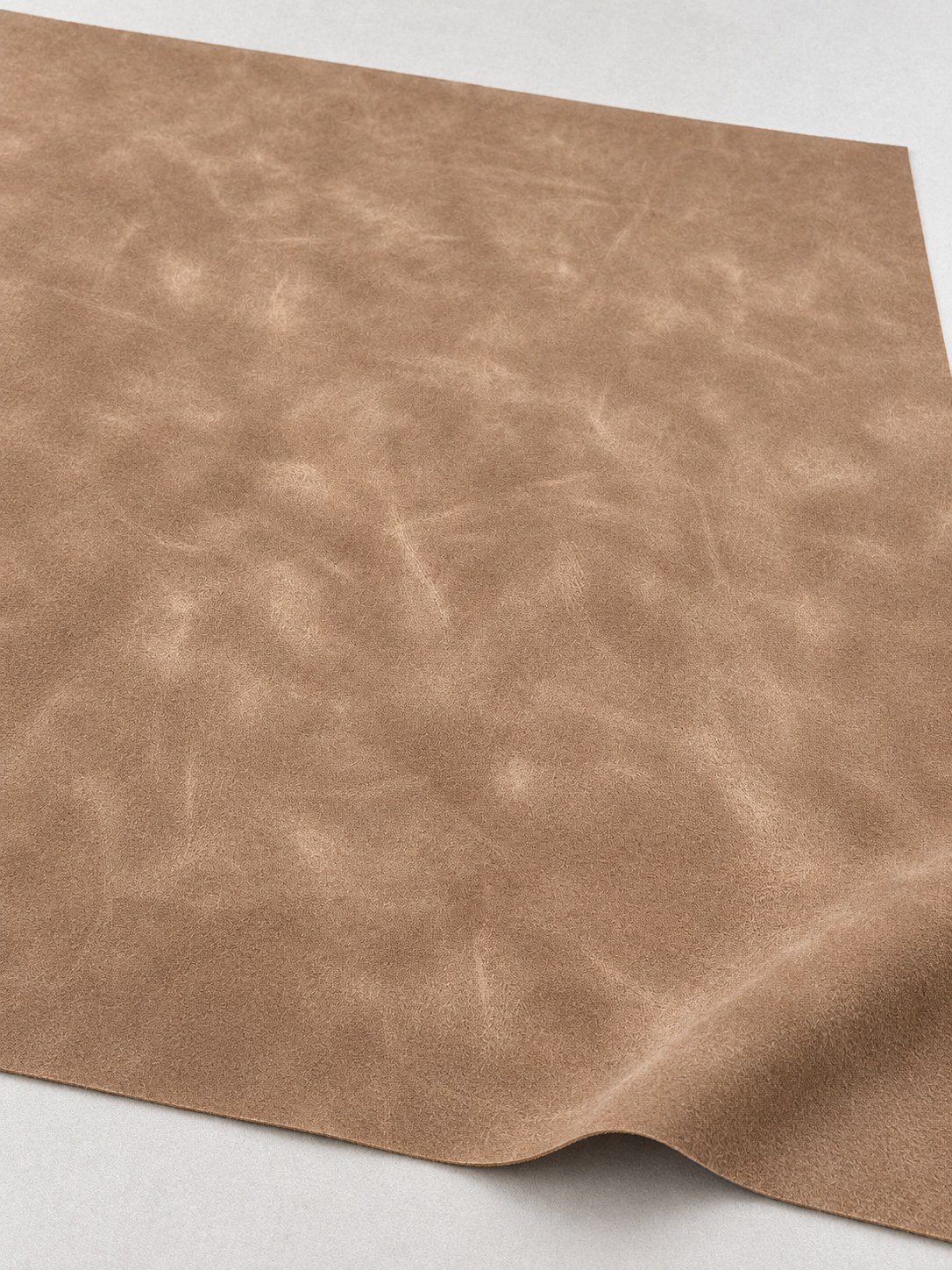
What to include in the test specification
| Parameter | Required information |
|---|---|
| Test method | Applicable AATCC rubbing method or buyer-specified equivalent |
| Test condition | Dry or wet |
| Rubbing cycles | Defined number of strokes |
| Applied load | According to the selected method |
| Assessment | Specified gray scale or transfer rating |
| Sample condition | Original, treated, or conditioned after cleaning |
| Acceptance level | Buyer-approved rating for the application |
For production approval, test the treated suede after the relevant finishing and conditioning process. If the material is intended for light-colored linings or socks, wet crocking deserves particular attention.
Do not confuse crocking with colorfastness to washing. Crocking evaluates color transfer through rubbing; washing colorfastness evaluates color change and staining under a defined washing procedure. Both may be needed for footwear, but they answer different questions.
5. Sustainable Suede Swatches for Footwear Development
Material sustainability assessment should consider more than the water-repellent treatment. Microfiber suede construction, fiber content, polymer chemistry, backing, finishing auxiliaries, and production processes all influence the material's environmental profile.
A PFC-free finish may support a brand's restricted-substance strategy, but it does not by itself establish that the complete suede material is sustainable.
What to request with sustainable suede swatches
For footwear development teams, a useful sample package should include:
- Fiber and backing composition.
- Surface and finishing description.
- Water-repellent treatment information.
- Relevant restricted-substance declarations.
- Available chemical compliance documentation.
- Initial water-repellency test results.
- Dry and wet crocking results, where tested.
- Cleaning and care recommendations.
- Sample identification and production-batch reference.
If a project requires recycled content, biodegradability, or other environmental claims, request evidence that specifically supports the claim for the supplied material. Do not infer recycled content or environmental certification from a PFC-free DWR finish.
Swatch approval checklist
| Development requirement | Approval question |
|---|---|
| Surface appearance | Does the suede match the approved color and nap? |
| Water repellency | Does it meet the defined initial rating? |
| Wash durability | Does it retain the required performance after specified cycles? |
| Hand-feel | Does it remain soft without a greasy surface? |
| Crocking | Does it meet the dry and wet transfer requirements? |
| Processing | Can it be cut, stitched, bonded, and assembled consistently? |
| Chemical requirements | Are declarations and test documents available for the project? |
| Repeat production | Can the approved appearance and performance be maintained between batches? |
💡 Sourcing Tip for Bulk Buyers
f a q

Q1: Does water-repellent microfiber suede make sneakers waterproof?
A1:No. A hydrophobic finish helps water bead on the treated surface, but it does not necessarily prevent water from entering through seams, stitching holes, unsealed edges, or other shoe components. Whole-shoe waterproofness requires a complete construction designed and tested for that purpose.
Q2: Can PFC-free DWR maintain water repellency after 30 washes?
A2:Some formulations may be developed to meet a 30+ wash target, but performance depends on the treatment chemistry, microfiber construction, washing method, and drying conditions. Buyers should request test results using a defined procedure rather than relying on the claim alone.
Q3: How can manufacturers preserve microfiber suede's soft hand-feel after hydrophobic treatment?
One-stop shoe material Factory in China
Require immediate engineering consultation or custom specification development for upcoming footwear material programs? Contact our technical sales engineering team directly at ace01@eurus-cn.com or call +86 13459576329 for 24/7 technical support, physical swatchbooks, and direct factory quotation matrices.


